Author: Dawn Holford, Research Lead ReCITE, School of Psychological Science, University of Bristol
What national policy tells us about building a creative health system for Liverpool
One of ReCITE’s objectives has been to understand how we can sustain community-led creative health in Liverpool. In co-designing our programme(link is external)(opens in a new tab) with stakeholders, we clearly identified that building a creative health system requires investment in stability and not just short-term projects.
As creative health gains national momentum, the challenge is no longer whether it matters, but how it becomes embedded within local systems, services, and policy. Across the UK, local authorities, health systems, cultural organisations, and community partners are beginning to develop strategies that move creative health from individual programmes towards long-term implementation.
For Liverpool, this presents an important opportunity: to learn not only from successful examples elsewhere, but also from the gaps and challenges that continue to limit progress nationally.
We are already seeing examples where this is happening. In 2022, Greater Manchester launched its Creative Health Strategy(link is external)(opens in a new tab), the first in the country. The National Centre for Creative Health’s Creative Health Associates programme(link is external)(opens in a new tab) has accelerated the incorporation of creative health into local and regional plans and strategies across the UK.
In a new analysis, we conducted a scoping review of 69 strategies, briefings, evaluations, and recommendations for implementing creative health in the UK. We explored how they make the case for creative health, what strategic actions they put forward, and the extent of citizen power they envisioned and documented.
Here are four main takeaways from our policy review:
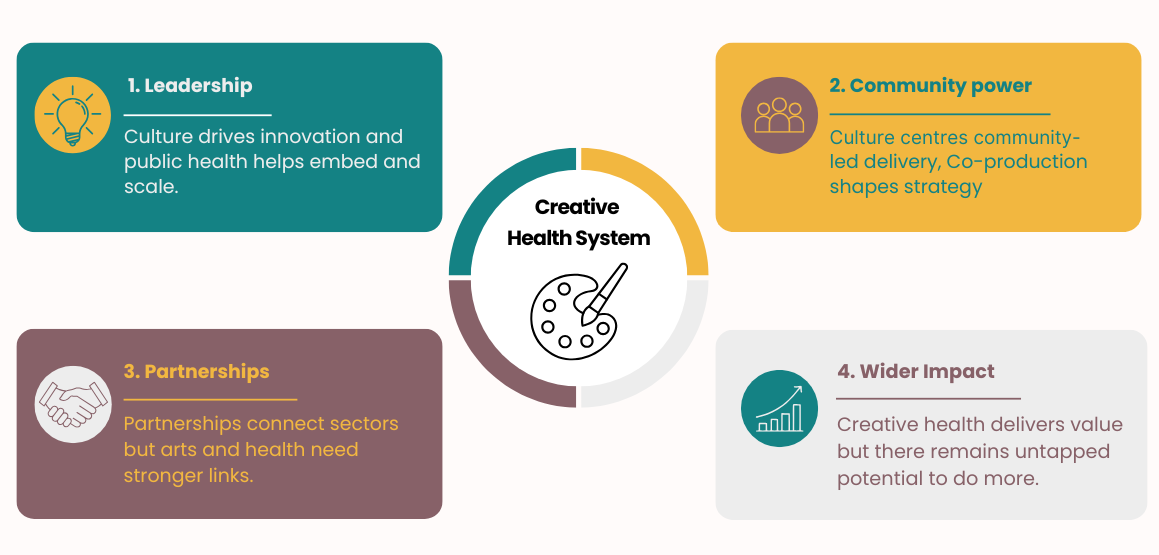
1) Cultue drives innovation - public health helps embed it
Culture teams are often the strongest champions of creative health, leading some of the most ambitious and community-connected work across the UK. However, where public health leadership is involved, creative health is more likely to become embedded at a systems level and linked to a wider range of health outcomes.
Culture-led strategies made up the largest proportion of policy documents in our review, demonstrating the important role the arts and cultural sector play in championing creative health. These strategies often focused on the benefits to mental health and wellbeing.
Public health-led strategies were fewer in number; however many were further advanced in implementation and more likely to connect creative health to prevention, physical health and the wider socio-economic determinants of health and inequity.
Taken together, the findings suggest that culture and public health teams may bring different strengths to creative health implementation.
2) Culture centres community-led delivery, co-production shapes strategy
Across the policies we reviewed, there was a strong ambition for creative health delivery to be community-led, with shared power over decision-making.
We also explored whether this power-sharing was observable in descriptions of how each document was developed. Here, a greater proportion of strategy produced by culture teams provided evidence of involving community members in decision-making processes. The strengths of the arts and cultural sector’s experiences in co-production and participatory practice may contribute to their stronger track record in this area.
These findings suggest that culture-led approaches can play a strong role in embedding community involvement not only in programme delivery, but also in the development of strategy itself.
3) Partnerships connect sectors, arts and health need stronger links
The most common theme across all recommended actions in the documents was for collaboration: partnership working with cross-sectoral and joined-up approaches that build networks and foster connections.
Despite this shared emphasis, partnerships between arts and healthcare organisations appeared less developed than might be expected. Culture-led policies identified relatively few healthcare partnerships compared with partnerships involving local government, community organisations, and the arts sector. Public health-led policies demonstrated a broader spread of partners overall.
Partnerships with VCSFE organisations appeared more frequently across the documents and may play an important role in connecting organisations across sectors.
4) Creative health delivers value, untapped potential remains
The policies we reviewed—particularly those led by public health teams—demonstrated growing recognition that creative health can contribute to a wide range of health outcomes. A growing body of case studies are cited, along with some high-profile reviews of research. The most frequent evidence cited was for the benefits to mental health and wellbeing (in 57% of documents).
At the same time, some important areas remain underdeveloped. Relatively few documents (12%) made a strong evidence-based case for creative health as a tool for addressing health inequities, despite this being a major priority for many local systems. There also remains significant untapped potential to connect creative health more explicitly to wider socio-economic priorities.
The review identified potential for further development in less explored areas, including tackling mis/disinformation, neighbourhood planning, and statutory advocacy. These emerging areas suggest opportunities to consider how creative health might contribute not only to individual wellbeing, but also to wider community and systems challenges.
Looking forward
This review provides an opportunity to reflect on documented progress being made in creative health implementation across the UK as well as the challenges that continue to limit systemic change. The evidence base on creative health continues to grow. The Mobilising Community Assets programme is helping to address the evidence gaps on the impacts creative health can have for improving health equity while the National Centre for Creative Health continues to provide examples of how creative health interventions are being implemented(link is external)(opens in a new tab) in services and systems across the country.
Within ReCITE, our Community Innovation Teams are providing a model for collaboration between health, arts, and community partners to co-produce creative interventions that tackle health equity issues identified at the hyperlocal level. This year, our Advocacy Network and Catalysing Change will demonstrate how community storytelling can help drive change in the ecosystem that perpetuates unequal health outcomes. Our Creative Health Exchange in October will connect partners from across Liverpool, aiming to build momentum towards a Creative Health Strategy for the region.
Altogether, the findings of our review suggest that stronger partnerships that harness the strengths of cultural, health, and community sectors will be key drivers of the leadership needed to embed creative health systems that support its sustained delivery.(link is external)(opens in a new tab)
About the review
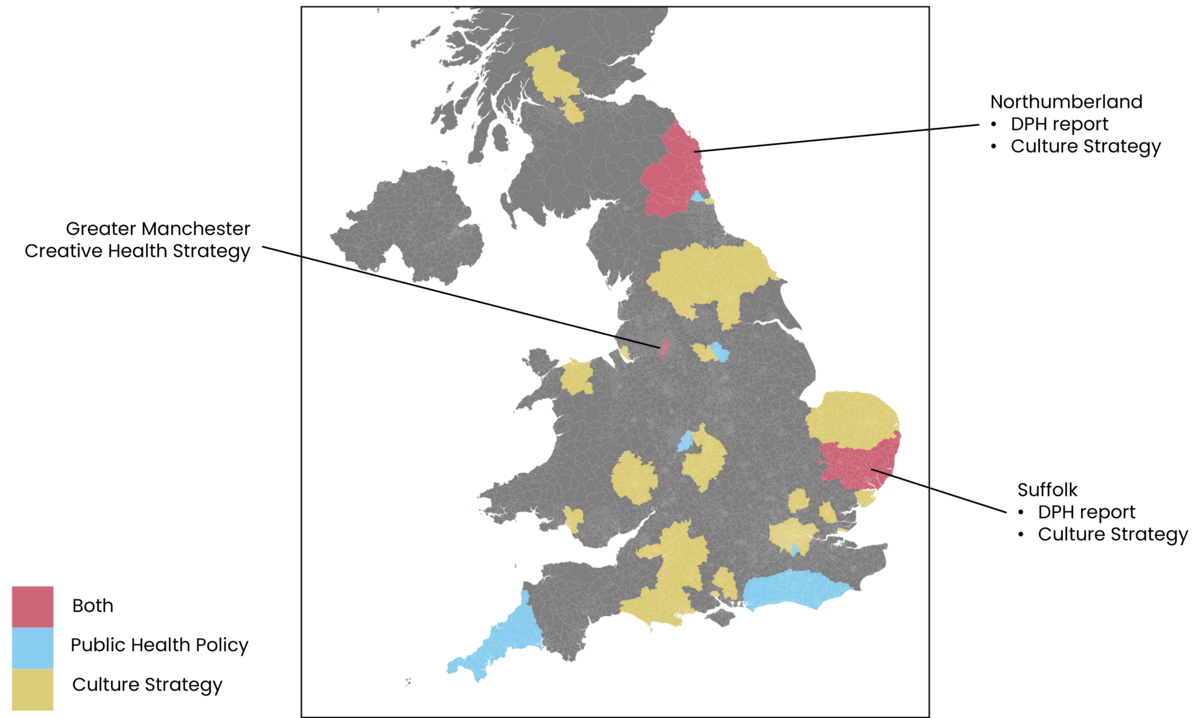
We reviewed 69 UK policy documents, strategies, evaluations, and public health reports relating to creative health implementation. These included national, regional, and local strategies led by cultural organisations, public health teams, and cross-sector partnerships.
Interested in continuing the conversation? The upcoming webinar “Creative Health in Policy: Where Are We Now and Where Next?”, hosted by Mobilising Community Assets with presentations from ReCITE and the National Centre for Creative Health, will explore how creative health has been integrated into UK policy to date and what this means for future strategy. The discussion will build on many of the themes explored in this review and consider where creative health policy may go next.
Register for the webinar(link is external)(opens in a new tab)
|
ReCITE is funded by the Arts and Humanities Research Council (AHRC), part of UK Research and Innovation. |
 |

Join our LinkedIn(link is external)(opens in a new tab) community.